
Where Can I See Hippos in Uganda?
May 2, 2026
How Do Lions Communicate? A Closer Look at Africa’s Most Social Big Cat
May 2, 2026
Watching a mother gorilla with her infant is one of the most moving sights in the wild. Their bond is deep, attentive, and remarkably similar to that of human mothers, yet shaped by the demands of life in the forest. From pregnancy to raising independent young, gorilla mothers take on an intense and continuous role that ensures the survival of their offspring in a challenging environment.
A Strong Bond from Birth
From the moment a baby gorilla is born, its mother becomes its entire world. She cradles the newborn carefully, holding it close to her chest for warmth, comfort, and protection. During the first months of life, the infant rarely leaves her body. In fact, she carries it almost constantly, whether she is moving through dense vegetation or feeding.
This constant closeness creates a powerful emotional bond. The infant learns to recognize its mother’s scent, voice, and movements, while the mother remains highly responsive to every small signal from her baby. If the infant cries or shows signs of discomfort, she reacts immediately. This level of attentiveness is essential because young gorillas are extremely vulnerable in their early stages of life.
At the same time, raising a baby gorilla is demanding. The mother must feed herself while carrying her infant, stay alert to threats, and ensure her baby’s safety at all times. Because of this intense investment, female gorillas typically give birth only once every four years. Even then, survival is not guaranteed, as some infants do not make it through the early stages of life.
Pregnancy and Preparation
Before the bonding begins, pregnancy itself is a quiet and subtle phase in a gorilla’s life. It lasts about eight and a half months, which is slightly shorter than a human pregnancy. However, unlike humans, it is not easy to tell when a gorilla is pregnant just by looking at her. Their naturally large bellies, shaped by a diet rich in vegetation, tend to conceal physical changes.
Even so, there are small signs that experienced observers notice. Pregnant gorillas may show changes in appetite or behavior. Some may eat more selectively, while others display signs similar to morning discomfort. These subtle shifts offer clues, but overall, pregnancy remains less visually obvious compared to humans.
As the pregnancy progresses, the mother continues her daily routine within the group. She feeds, travels, and rests alongside other members, all while carrying the developing infant. This ability to maintain normal activity reflects the resilience and adaptability of gorillas in the wild.
Hands-On Motherhood
Unlike in many human societies where caregiving is often shared, gorilla mothers take on most responsibilities themselves. They rarely leave their infants in the care of others. For the most part, the baby stays with its mother day and night, creating a constant and intimate connection.
Occasionally, however, a mother may allow a trusted individual to interact with her baby. This is usually limited to older siblings or closely related females within the group. Even then, the interactions are brief and closely monitored. The mother remains nearby, ready to take her infant back at the slightest sign of discomfort or danger.
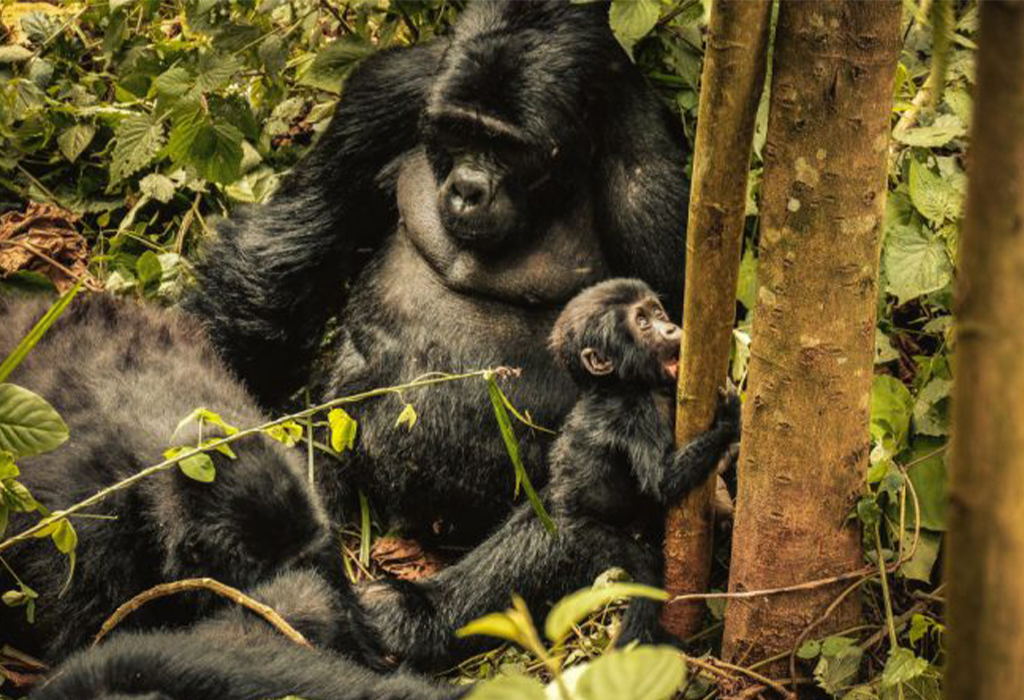
This protective behavior highlights how cautious gorilla mothers are. Trust is not easily extended, and the infant’s safety always comes first. As a result, the young gorilla grows up under nearly constant maternal supervision during its earliest and most vulnerable months.
Protection in a Complex Social World
Life within a gorilla group offers both safety and challenges. Typically, the dominant silverback plays a key role in protecting the group from external threats, including rival males. However, mothers also play an active role in safeguarding their young, especially in uncertain situations.
When a group becomes unstable, such as after the loss of a silverback, the risk to infants increases. New dominant males may pose a threat to young gorillas that are not their own. In such situations, mothers must make difficult decisions to protect their offspring.
There have been rare and striking observations of mothers acting independently to shield their infants from danger. In one such case, a mother chose to leave her group and travel alone with her young baby rather than risk joining another group where the infant might be harmed. This decision exposed her to new dangers, yet it demonstrated an extraordinary level of maternal commitment.
Although not all such stories have happy endings, they reveal the lengths to which gorilla mothers will go to protect their young. Their actions are guided by instinct, but they also reflect a deep and powerful bond between mother and child.
Nurturing Growth and Independence
As the infant grows, the mother gradually adjusts her care. For the first six months, she keeps the baby almost constantly in contact with her body. This close contact provides warmth, security, and easy access to milk. At night, the infant sleeps in the same nest as its mother, curled safely beside her.
Around five months of age, the young gorilla begins to show curiosity about solid food. It starts by tasting small amounts while still relying heavily on its mother’s milk. By about eight months, solid food becomes a more regular part of its diet, although nursing continues for several years.
This gradual transition allows the infant to develop strength and independence at a steady pace. Meanwhile, the mother remains patient and attentive, guiding her young through each stage of growth.
However, this close relationship eventually changes. When the mother gives birth to another infant, usually after about four years, the older offspring must become more independent. It begins to sleep in its own nest and rely less on maternal care. While this transition may seem abrupt, it is a natural part of gorilla life and helps prepare the young gorilla for adulthood.
A Remarkable Model of Motherhood
Mother gorillas demonstrate a form of parenting that is both demanding and deeply nurturing. They combine constant physical care with strong emotional bonds, all while navigating the challenges of life in the wild. Their approach may differ from human parenting in certain ways, yet the core elements protection, sacrifice, and dedication remain strikingly similar.
By observing these incredible animals, one gains a deeper appreciation for the universal nature of motherhood. Whether in a forest or a human home, the drive to nurture and protect the next generation remains one of the most powerful forces in the natural world.