Gorilla Trekking in Volcanoes National Park
September 16, 2026
What Is the Best Kenya Safari for Solo Travelers?
September 17, 2026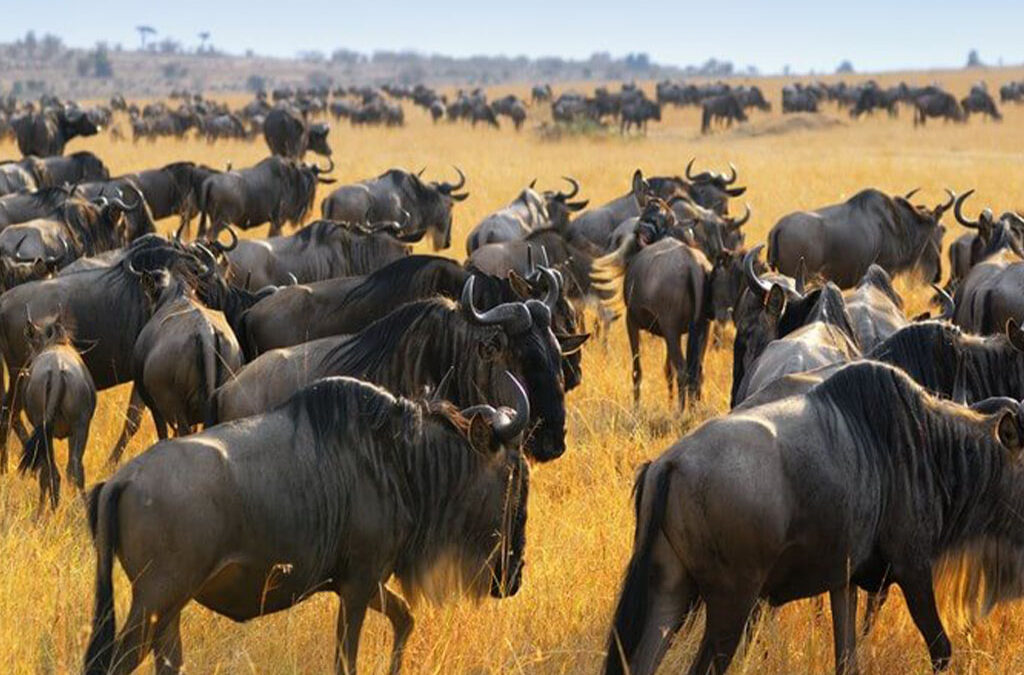
The Great Wildebeest Migration is one of Africa’s most remarkable wildlife spectacles. Every year, millions of wildebeest, together with large numbers of zebras and gazelles, move across the Serengeti-Mara ecosystem in search of fresh grazing and water. Although people often describe it as a single journey, the migration is actually a continuous annual cycle that covers different parts of Tanzania and Kenya at different times of the year.
For travellers planning a migration safari, choosing the right destination and travel period is essential. The herds do not follow a fixed timetable, because their movements depend heavily on rainfall, pasture and water availability. Nevertheless, certain areas provide particularly good opportunities to experience different stages of the migration.
From the calving plains of southern Serengeti to the dramatic Mara River crossings in northern Serengeti and Kenya’s Maasai Mara, each region offers a different perspective of this extraordinary natural event.
Ngorongoro Conservation Area and Ndutu Plains
The Ndutu Plains lie between the southern Serengeti and the Ngorongoro Conservation Area. This region consists largely of open grasslands, scattered acacia woodland and rocky outcrops, creating ideal conditions for large grazing herds.
Between January and March, the area becomes one of the most important destinations for witnessing the wildebeest calving season. During this period, hundreds of thousands of calves are born across the short-grass plains. Zebras and gazelles also gather in large numbers, creating an impressive concentration of wildlife.
However, the abundance of young animals also attracts predators. Lions, cheetahs, leopards and hyenas take advantage of the vulnerable newborns, making this period particularly interesting for visitors who want to observe predator-prey interactions.
Beyond the wildlife, the Ndutu region offers striking scenery and important archaeological attractions. Olduvai Gorge, located within the wider Ngorongoro Conservation Area, is one of East Africa’s most significant archaeological sites and has contributed greatly to the understanding of early human evolution.
Lake Ndutu is another attraction in the area. The alkaline lake provides feeding habitat for lesser flamingos and adds variety to the landscape.
Maswa Game Reserve
Southwestern Tanzania’s Maswa Game Reserve forms an important part of the wider Serengeti ecosystem. Together with neighbouring conservation areas, it provides additional habitat for wildlife moving through the region.
The reserve also serves as a buffer between protected areas and surrounding communities. Conservation initiatives in the region have helped protect wildlife habitats while supporting efforts to reduce poaching and pressure on the ecosystem.
For travellers seeking a quieter safari experience, areas around the southern Serengeti and Maswa can provide an appealing alternative to some of the busier migration destinations.
Central Serengeti and the Western Corridor
As the rains change and fresh grazing becomes available, the herds gradually move northwards from the southern Serengeti. Around April and May, many animals spread across the central Serengeti before continuing towards the western corridor.
The Seronera area forms the heart of central Serengeti. Its permanent water sources support wildlife throughout the year, so visitors can see resident populations of lions, leopards, cheetahs, elephants, giraffes and numerous antelope species even when the migration has moved elsewhere.
The landscape is also famous for its granite kopjes. These rocky formations rise above the grasslands and provide excellent vantage points for predators. Simba Kopjes are particularly well known, while the Moru Kopjes feature distinctive rock formations and ancient cultural sites.
The Moru Kopjes area can also provide opportunities to see black rhinoceros, although sightings are not guaranteed.
As the migration continues westwards, some of the herds eventually reach the Grumeti River. This marks one of the first major river-crossing areas on the northern journey. The crossings can be dramatic, with wildebeest gathering along the riverbanks before entering the water.
Northern Serengeti and the Mara River
Northern Serengeti is one of the most popular regions for travellers hoping to witness the migration between approximately July and October. The Kogatende area, in particular, is well positioned along the route towards the Mara River.
The exact timing of the herds varies from year to year. However, July and August are traditionally associated with some of the most anticipated river-crossing activity.
The Mara River forms part of the boundary between Tanzania and Kenya and provides one of the most iconic scenes associated with the Great Migration. Wildebeest may gather on the banks for hours before one group finally enters the water. Once they begin crossing, the movement can become chaotic as hundreds or thousands of animals attempt to navigate strong currents, steep banks and waiting crocodiles.
The northern Serengeti also supports resident wildlife throughout the year. Lions, leopards, cheetahs and other predators can be encountered even when the migration is not passing directly through the area.
Kenya’s Maasai Mara
Kenya’s Maasai Mara National Reserve forms the northern extension of the Serengeti-Mara ecosystem. The reserve is considerably smaller than Serengeti National Park, but it plays an important role in the annual migration cycle.
The wildebeest generally enter the Maasai Mara between around July and October, although the timing changes according to rainfall and conditions on the ground.
The Mara River is one of the main attractions during this period. River crossings can produce spectacular wildlife scenes as wildebeest move through the water while crocodiles wait for opportunities to strike.
Because the Maasai Mara is highly popular, the busiest areas can experience significant concentrations of safari vehicles during peak migration periods. Travellers looking for a quieter experience can consider conservancies bordering the main reserve, where regulations and visitor numbers may differ.
Accommodation ranges from simple camps to high-end safari lodges and tented camps. As a result, visitors can choose options that suit different budgets and travel styles.
Eastern Serengeti
The eastern Serengeti provides another opportunity to experience the migration, particularly as the herds begin their return journey towards the southern plains.
The region features open savanna, acacia trees and rocky outcrops, including the well-known Gol Kopjes. It is also an excellent habitat for predators and smaller antelope such as Grant’s and Thomson’s gazelles.
Around October and November, many wildebeest begin moving southwards. Because the herds can spread out over a large area, locating them requires flexibility and good knowledge of recent wildlife movements.
Even when the migration is difficult to predict, eastern Serengeti remains rewarding for general wildlife viewing.
The region also lies close to Ol Doinyo Lengai, an active volcano regarded as sacred by the Maasai. Nearby Lake Natron provides important breeding habitat for lesser flamingos and offers a very different landscape from the grasslands of the Serengeti.
Why the Wildebeest Migration Moves
The wildebeest migrate primarily in response to the availability of fresh grazing and water. Seasonal rainfall causes new grasses to grow in different parts of the Serengeti-Mara ecosystem, encouraging the herds to keep moving.
The migration also involves zebras and several species of antelope. Different grazers feed on vegetation in different ways, allowing them to share the same ecosystem.
Although the general migration pattern is well understood, the exact movements of the herds remain difficult to predict. Rainfall can arrive earlier or later than expected, and the animals can change direction depending on local conditions.
For this reason, no safari operator can guarantee a particular river crossing on a specific day. Experienced guides, however, monitor animal movements and local conditions to improve the chances of finding the herds.
Predators and the Circle of Life
The migration attracts large numbers of predators. Lions, cheetahs, leopards and hyenas follow the availability of prey, while crocodiles wait in some of the rivers crossed by the herds.
Young wildebeest are especially vulnerable during the calving season. At the same time, adult wildebeest are powerful animals capable of defending themselves against predators.
The sheer size of the herds also provides protection. When threatened, wildebeest can gather together, with adults surrounding younger animals. Their constant movement and alert behaviour help them respond quickly when predators approach.
The Drama of the River Crossings
River crossings have become one of the defining images of the Great Wildebeest Migration. However, they are not guaranteed simply because a traveller visits during the traditional migration season.
Wildebeest can gather along a riverbank for long periods before crossing. Sometimes they approach the water and retreat several times before eventually entering.
Once the movement begins, thousands of animals may follow. They must negotiate steep riverbanks, deep water, strong currents and crocodiles.
For travellers, the experience can be extraordinary, but patience is important. The migration follows nature’s timetable rather than a tourist schedule.
Tanzania or Kenya for a Migration Safari?
Both Tanzania and Kenya provide access to the Serengeti-Mara ecosystem, but each offers a different safari experience.
Tanzania’s Serengeti is much larger than Kenya’s Maasai Mara and provides opportunities to follow different stages of the migration across a broader area. Visitors can combine the migration with other northern Tanzania attractions, including the Ngorongoro Conservation Area.
Kenya’s Maasai Mara is smaller and has a well-established tourism network. It can be convenient for travellers with limited time, particularly those focusing on the northern section of the migration.
Tanzania’s larger ecosystem also means that visitors can explore less crowded areas by choosing their accommodation and safari route carefully. Meanwhile, Kenya offers a wide selection of accommodation styles around the Maasai Mara and neighbouring conservancies.
The best choice depends on the traveler’s available time, preferred safari style, budget and the particular stage of the migration they want to experience.
Where Does the Wildebeest Migration Start and End?
The migration has no single starting point or final destination. Instead, it operates as a continuous cycle that repeats throughout the year.
The cycle is often described as beginning with the calving season in the southern Serengeti and Ndutu Plains. After the calves are born, the herds gradually move northwards through the Serengeti.
They then travel towards the western corridor before reaching the northern Serengeti and Mara River. Some herds cross into Kenya’s Maasai Mara, where they remain for a period before gradually turning southwards.
Eventually, the animals return towards the southern Serengeti, completing another part of the cycle.
When Is the Best Time to See the Migration?
The best time depends on which part of the migration you want to see.
January to March is particularly important for travellers interested in the calving season around Ndutu and the southern Serengeti. April and May generally correspond with the movement through the central and western Serengeti, although heavy rains can affect travel conditions.
From around July to October, the northern Serengeti and Maasai Mara become important areas for migration viewing, with the Mara River crossings attracting considerable attention.
Around October and November, the herds begin moving southwards again. December then brings many animals back towards the southern Serengeti as the annual cycle continues.
Because weather patterns vary, travellers should avoid treating these periods as rigid dates.
Is the Wildebeest Migration in Danger?
The Serengeti-Mara ecosystem faces several conservation challenges. Wildlife must share landscapes with growing human populations, agriculture, livestock grazing, tourism infrastructure and other forms of development.
Conservation areas and wildlife corridors play an important role in maintaining movement routes between protected areas. Community-based conservation initiatives can also create economic incentives for local people to protect wildlife and maintain habitats.
Climate variability presents another challenge. Changes in rainfall patterns, droughts and flooding can influence the availability of grass and water, potentially affecting the timing and distribution of the migration.
Protecting the migration therefore requires cooperation between governments, conservation organisations, tourism businesses and communities living around the ecosystem.
Planning Your Wildebeest Migration Safari
Planning a migration safari requires more than simply selecting a month on the calendar. Since the herds respond to rainfall and grazing conditions, travellers should choose their destination based on the stage of the migration they hope to experience.
If calving is the priority, the southern Serengeti and Ndutu Plains are important areas to consider. For the western movement, central Serengeti and the western corridor offer good opportunities. Travellers interested in river crossings should consider northern Serengeti or the Maasai Mara during the period when the herds are in those regions.
Working with an experienced safari operator such as Experiya Tour Company can also help with route planning, accommodation selection, park logistics and changes in animal movements.
Most importantly, travellers should approach the migration with realistic expectations. Wildlife operates according to natural conditions, so even the most carefully planned safari cannot guarantee a specific sighting.
Experience the Great Wildebeest Migration
The Great Wildebeest Migration is much more than a dramatic river crossing. It is an ongoing ecological cycle involving wildebeest, zebras, gazelles, predators, rivers, grasslands and local communities.
From newborn calves taking their first steps in Ndutu to herds moving across the Mara River, every stage reveals a different side of the Serengeti-Mara ecosystem.
With careful planning and the right safari route, travellers can experience this remarkable natural process while also discovering the landscapes, wildlife and cultures that make Tanzania and Kenya exceptional safari destinations.