How Long Does a Gorilla Trek Take?
August 30, 2025
What is a Boat Cruise to Murchison Falls Like?
September 1, 2025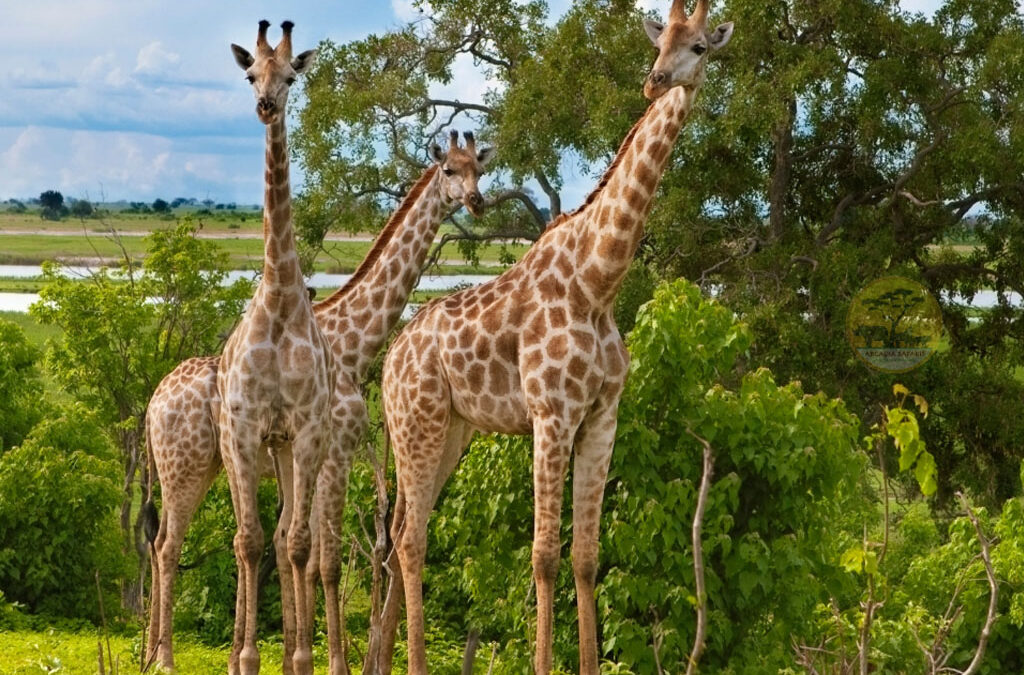
When people talk about rare mammal species in Uganda, the mountain gorilla is often the first that comes to mind. However, Uganda is also home to an even rarer mammal the Rothschild’s giraffe (also called the Uganda giraffe or Baringo giraffe). Today, the total number of wild Rothschild’s giraffes is estimated at around 3,000 individuals, spread across Uganda and Kenya. Sadly, the species is already extinct in South Sudan. This makes the Rothschild’s giraffe one of the rarest mammals in the world.
For comparison, although still endangered, more than 1,000 mountain gorillas now inhabit the Afro-montane forests of Uganda, Rwanda, and the Democratic Republic of Congo.
Conservation Status of the Rothschild’s Giraffe
Since 2007, the Rothschild’s giraffe has been recognized as a distinct species rather than a subspecies. In 2012, the International Union for Conservation of Nature (IUCN) listed it as endangered. Without immediate and consistent conservation action, the Rothschild’s giraffe could face extinction in the near future.
What makes this even more concerning is that there are nearly as many Rothschild’s giraffes living in zoos around the world as there are in the wild.
Historical and Current Distribution in Africa
Originally, Rothschild’s giraffes roamed from the Rift Valley of west-central Kenya across Uganda to the Nile River and into southern South Sudan.
Today, their natural distribution has drastically shrunk. In the wild, large free-ranging populations survive only in Uganda, while in Kenya small, reintroduced populations live in fenced reserves such as Lake Nakuru National Park. Unfortunately, these Kenyan populations remain isolated, making genetic mixing and healthy breeding nearly impossible.
The steep decline of Rothschild’s giraffes began during the 1960s and 1970s, largely due to civil unrest and uncontrolled hunting. From a population of about 2,000 individuals in 1960, the numbers dropped to a shocking 200 by 1999. Currently, the greatest threats to their survival include:
- Rapid human population growth
- Habitat loss and encroachment
- Segregation of giraffe populations
- Severe poaching
- Human-wildlife conflicts
Distribution of Rothschild’s Giraffes in Uganda
Uganda is now the stronghold of the Rothschild’s giraffe. This is the only giraffe species you will encounter in the country, mainly found in the northern savannah parks.
- Murchison Falls National Park: Home to the largest population, estimated at over 1,500 individuals today. Back in 1991, only 78 individuals remained here, showing remarkable recovery due to strict protection measures by the Uganda Wildlife Authority (UWA).
- Kidepo Valley National Park: In 1970, about 400 giraffes roamed here. By 1995, only five remained. In 1997, three individuals were translocated from Kenya’s Lake Nakuru National Park to help restore the population. Today, Kidepo has around 65 individuals.
- Lake Mburo National Park: In June and July 2015, UWA translocated 15 Rothschild’s giraffes from Murchison Falls to Lake Mburo to establish a new, self-sustaining population.
Future plans include introducing Rothschild’s giraffes into Queen Elizabeth National Park and the southern sector of Murchison Falls National Park to spread out the population and reduce the risk of losing large numbers to disease or habitat threats.
Conservation Efforts and Rescue Missions
Conservationists and UWA have intensified efforts to save this rare giraffe. Translocation programs aim to spread populations across multiple parks, making them less vulnerable to localized threats such as diseases, poaching, or human encroachment.
However, challenges remain. Despite warnings from environmental reports in 2011 that oil exploration in Murchison Falls National Park would severely harm wildlife, including Rothschild’s giraffes, oil drilling has proceeded. This has already caused habitat destruction, putting additional pressure on this endangered species.
Conclusion
When you visit Murchison Falls National Park, Kidepo Valley National Park, or Lake Mburo National Park, remember that the Rothschild’s giraffes you see are among the last of their kind. Their survival depends on urgent conservation measures, responsible tourism, and strong policies that prioritize wildlife over destructive economic activities.
At Experiya Tour Company, we believe it is our collective responsibility to ensure that these unique giraffes never go extinct. Protecting them today secures their survival for generations to come.
For more information, visit: www.experiyatourcompany.com