Try Uganda’s Delicious Local Cuisine
March 7, 2026
Rwanda’s Habituated Gorilla Families
March 7, 2026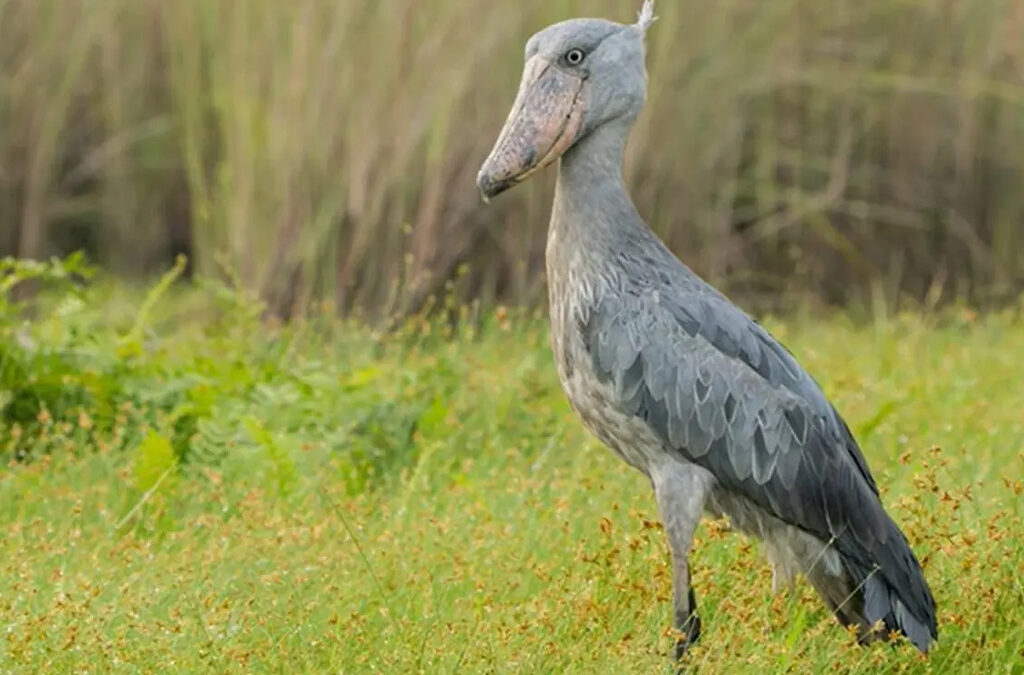
The shoebill (Balaeniceps rex), often called the whale-headed stork, is one of Africa’s most intriguing and mysterious birds. Its name comes from its enormous, shoe-shaped bill, which looks like a classic Dutch clog and ends in a sharp hook resembling a nail. This prehistoric-looking bird has captivated birdwatchers and wildlife enthusiasts around the world, earning a reputation as one of Africa’s most sought-after sightings.
Experiya Tour Company frequently guides visitors to prime shoebill habitats in Uganda and Zambia, ensuring travelers get the best chance to witness this majestic bird in its natural environment.
The Shoebill’s Unique Appearance
One glance at a shoebill and it’s impossible not to be captivated. Standing up to 1.5 meters tall with broad wings spanning up to 2.5 meters, the bird exudes an imposing presence. Its grey feathers, long legs, and piercing yellow eyes add to its prehistoric aura, making it resemble a creature straight out of a lost world.
Despite its size, the shoebill moves slowly and deliberately. It flaps its wings at roughly 150 flaps per minute, making it one of the slowest-moving birds in flight. However, this deliberate pace doesn’t affect its hunting prowess it is an expert predator in the swamps of East Africa.
The Shoebill’s Family Tree
For years, the shoebill was grouped with storks in the order Ciconiiformes. However, DNA studies have revealed that its closest living relative is the hamerkop, another uniquely odd African bird. Today, ornithologists classify the shoebill alongside pelicans, herons, and ibises in the order Pelicaniformes.
This taxonomic shift highlights the bird’s evolutionary distinctiveness, but regardless of classification, the shoebill continues to captivate wildlife enthusiasts with its mysterious behavior and striking appearance.
Where to Spot a Shoebill
Shoebills are secretive and solitary, often hiding in dense papyrus swamps. Their distribution across tropical East Africa closely follows the availability of their preferred prey, especially lungfish, and suitable nesting habitats in wetlands.
Experiya Tour Company offers carefully curated excursions to the best shoebill-watching spots. In Uganda, the swamps of Mabamba and the wetlands around Lake Albert provide excellent opportunities, while Zambia’s Bangweulu Wetlands remain a hotspot for serious birdwatchers. Patience and quiet observation are essential, as the shoebill’s slow, deliberate movements can make it both a challenge and a reward to spot.
Hunting and Diet: The Shoebill’s Deadly Precision
Shoebills are ambush hunters. They stand motionless for long periods, waiting for prey to come within striking distance. Their diet is diverse but heavily reliant on lungfish, which explains their close association with papyrus swamps and other wetlands.
Beyond lungfish, shoebills also feed on frogs, water snakes, snails, turtles, waterbirds, and even newborn crocodiles. While some unverified claims suggest that shoebills may prey on baby lechwe antelopes, most observations confirm that fish and amphibians make up the bulk of their meals.
Interestingly, shoebills benefit from living near hippos. These massive mammals churn the waters and create clear paths through dense papyrus, giving shoebills easier access to fish. Hippos also push fish toward the water’s surface, effectively providing a free buffet for the patient bird.
Reproduction: A Harsh Lesson in Survival
Shoebills are solitary breeders and rarely raise more than one chick per season. Occasionally, two or more eggs are laid, but this leads to a brutal survival hierarchy. The older, stronger chick often harasses the weaker sibling, denying it food and sometimes even killing it—a phenomenon observed in other predatory birds like eagles.
Though it may seem harsh, this strategy ensures that the strongest offspring survive in a habitat where resources can be scarce. Nature’s ruthless efficiency at work, it guarantees that at least one healthy chick reaches adulthood.
Shoebills and Conservation
Despite their fascination and uniqueness, shoebills face growing threats from habitat destruction and human disturbance. Wetland drainage, agricultural expansion, and hunting have put pressure on their populations, making them increasingly vulnerable.
Experiya Tour Company is committed to responsible wildlife tourism. By guiding travelers to shoebill habitats without disturbing the birds, the company supports conservation efforts and local communities who rely on sustainable tourism. Observing a shoebill in the wild is not just a bucket-list experience it’s an opportunity to appreciate the delicate balance of Africa’s wetland ecosystems.
Why Shoebills Captivate Humans
The shoebill’s slow, deliberate movements, enormous size, and piercing gaze make it an unforgettable sight. Birdwatchers often describe the moment of spotting a shoebill as magical—a silent encounter with a living relic of prehistoric Africa. Its mysterious behavior, combined with its solitary and enigmatic nature, creates an aura of reverence and fascination.
Experiya Tour Company ensures that travelers experience this awe firsthand. With expert guides and carefully timed excursions, visitors witness the shoebill in a way that is both safe and respectful to the bird and its habitat.
Planning Your Shoebill Adventure
For those eager to see a shoebill, planning is essential. Early morning visits increase the chances of sightings when the birds are most active. Comfortable clothing, binoculars, and patience are key. Most importantly, traveling with an experienced operator like Experiya Tour Company ensures a rewarding and environmentally responsible experience.
Whether you are a seasoned birdwatcher or a nature enthusiast, encountering the shoebill is a once-in-a-lifetime moment. From its prehistoric appearance to its deadly hunting skills and secretive lifestyle, the shoebill embodies the wild spirit of Africa’s wetlands.
Conclusion
The shoebill is more than just a bird it is a living legend of Africa’s swamps and wetlands. Its immense size, unique appearance, and captivating behavior make it a bucket-list sight for travelers from around the world. By exploring its habitats responsibly with Experiya Tour Company, visitors not only witness this extraordinary creature but also contribute to the protection of its fragile ecosystem.
From lungfish to hippos, from papyrus swamps to breathtaking sunsets, the shoebill connects us to a wild and mysterious world that few other birds can rival. Seeing one is not just an observation it is an unforgettable experience that inspires wonder, respect, and a deeper appreciation for Africa’s natural treasures.